Preparing for Tomorrow’s Most Valuable Piglets, Today
By Corey Carpenter
Director of Business Development & Swine Technical Sales, DPI GLOBAL
The Season Ahead
As we approach fall and winter we can expect shifts in many aspects of pig production. This also means we will farrow piglets over the next 3 to 6 months that will market next year at a time when we expect seasonal pig prices and profits to be at their highest. It is not too late to double-check that every effort has been made to set your pigs and business up for success through seasonal changes, challenges and expected market dynamics that lie ahead.
The Cost of Stillborns
Despite the operational challenges that come with seasonal changes, there is a constant we shouldn’t forget about: throughput is one of the most important aspects to minimize costs and maximize net income opportunities. The number of weaned pigs produced per sow per year is a major indicator of sow productivity that significantly contributes to driving throughput. However, the incidence of stillborns reduces sow productivity and throughput opportunities.
Stillborn piglets are born dead and would have otherwise been considered to have a high potential to thrive because they often represent some of the heaviest-weight piglets in the litter. This is important because heavier piglets go on to be more productive throughout the growing phases and have greater chance for survival prior to weaning (Feldpausch et al., 2019). Most producers and nutritionists recognize the negative impact stillbirths can have on an operation but struggle to find the right tools to improve piglet survivability.
Improving Piglet Survivability with Micro-Aid®
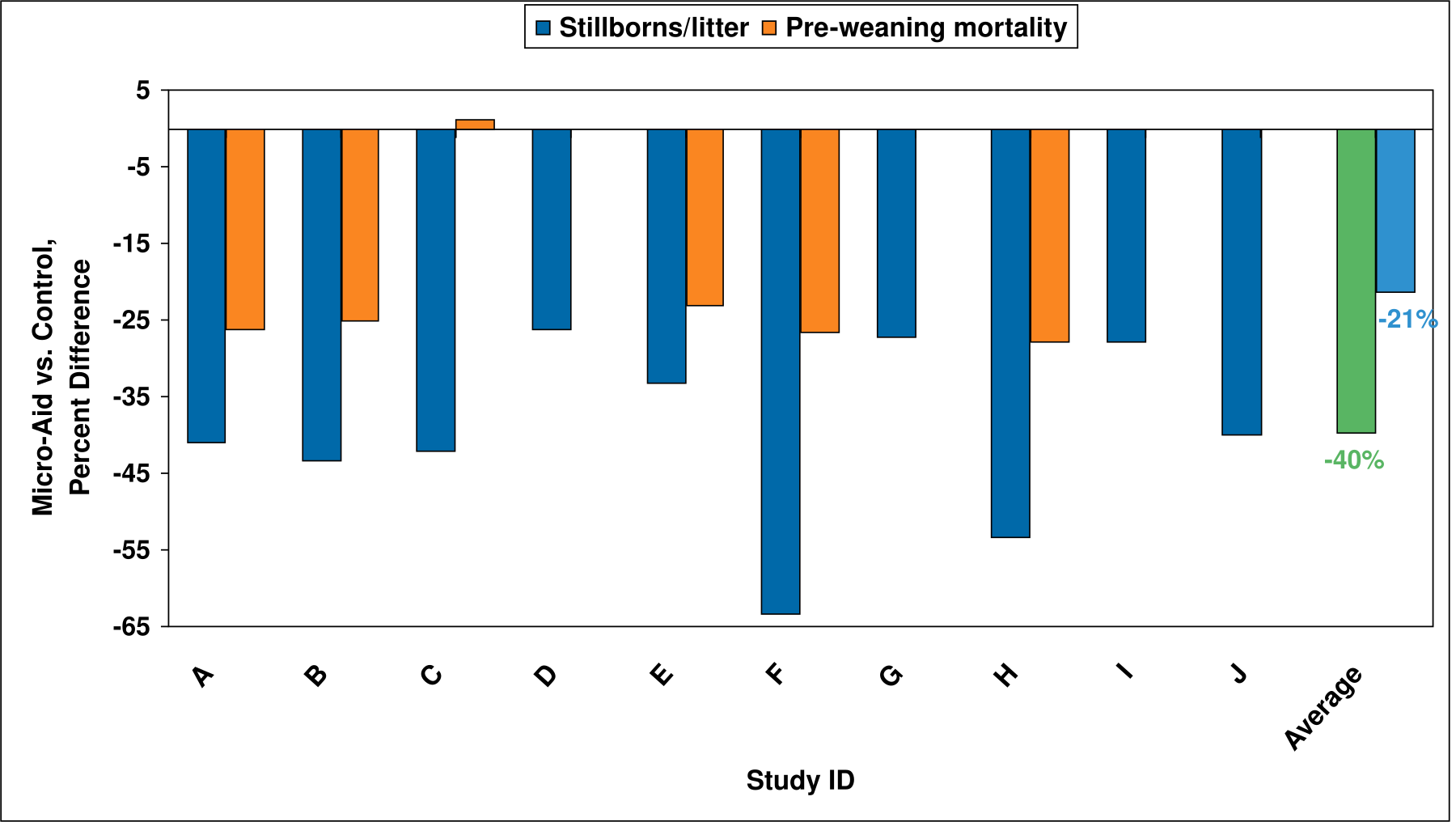
Research shows the incidence of stillbirths and pre-weaning mortality is reduced under varying production situations. Furthermore, a meta-analysis of these studies conducted over several years reveals a 21% reduction in pre-wean mortality and a 40% reduction in stillborns in sows fed Micro-Aid (Figure 1).
Because the bio-active components of Micro-Aid lower intestinal ammonia concentration and slow down gut mucosal cell turnover, less oxygen is consumed by the gastrointestinal tract. As a result, there is more oxygen available at the time of parturition in the uterine environment for piglets at the time of parturition, which reduces the incidence of stillborns.
The Economic Opportunity
Ultimately, successful interventions aimed at improving performance must pay for themselves and provide a return to the producer. Modeling estimates based on 1,500 productive sows and a 21% improvement in pre-wean mortality indicate a weaned pig cost savings of approximately $1.45 per weaned pig or about $42.47 per sow per year.
The financial opportunity shown here is important to consider in the overall profitability of swine systems for at least two major reasons. First, sow farms are generally considered a cost center for producing piglets, but feeding Micro-Aid to sows lowers weaned pig cost by reducing stillbirths and improving piglet survival, which drives throughput and gives producers a competitive and strategic economic advantage.
Second, piglets farrowed over the next several months will be some of the most valuable piglets marketed throughout 2027, which means reducing costs at the sow farm by optimizing throughput helps maximize revenue opportunities when these pigs go to market. Coupling scientific evidence with economic-based decisions means producers have an opportunity to take advantage of proven technologies through expected seasonal market dynamics to maximize revenue and reduce cost of production.
Micro-Aid should be considered by producers and nutritionists as a viable tool because of the reductions in stillborns and pre-wean mortality, improvements in piglet survivability, opportunities for economic return, and production efficiency.
The Time to Prepare Is Now
The time to reconsider whether you are doing everything you can to improve piglet survivability, drive throughput, and reduce costs at the sow farm is now!
For more than 60 years, DPI GLOBAL has worked alongside producers to provide all-natural, research-backed solutions that support animal health, performance, and production efficiency.
Contact us or visit www.dpiglobal.com to learn more about the ways Micro-Aid can be implemented to provide a meaningful return to your system!
Meet the Author: Corey Carpenter
Director of Business Development & Swine Technical Sales, DPI GLOBAL
Corey is the Director of Business Development and Swine Technical Sales at DPI GLOBAL, where he leads and directs the swine business and development of new business opportunities that grow the impact of DPI’s products and solutions in many species across the globe. Through a trust centered and results driven approach, Corey helps guide customers to effective, profitable nutrition solutions that help them achieve their long-term business goals.
When Corey is not working with livestock producers he enjoys CrossFit, spending time with family around their animals, and cooking.
References
Feldpausch, J. A., J. Jourquin, J. R. Bergstrom, J. L. Bargen, C. D. Bokenkroger, D. L. Davis, J. M. Gonzalez, J. L. Nelssen, C. L. Puls, W. E. Trout, and M. J. Ritter. 2019. Birth weight threshold for identifying piglets at risk for preweaning mortality. Translational Animal Science. 3:633–640. doi:10.1093/tas/txz076.